
The World Cup from the Inside

Everybody with a laptop is writing about the World Cup this month. I figure I have earned a different angle. I worked it.
When I was a kid, soccer was the sport for the kids who were too small, or too “weak” (they were not, but that is what we said), to play a real sport like football. The American version. Then my freshman year of high school, our soccer team scored more points than the varsity football team and won the sectional championship. Let that sink in for a second, a sport that gives you 1 point for a goal out scored a sport that gave you 6 (7 when the extra point) It did not matter. More people still went to the football games. Friday night lights was the whole show: homecoming, the dance, the parade, the entire American high school experience wrapped around one sport.
Our Soccer team was good but nobody cared. Which taught me something I did not have words for at fifteen: we do not watch sports for the sport. We watch them for the story we have already agreed to tell about ourselves. Football was our story. Soccer was somebody else’s.
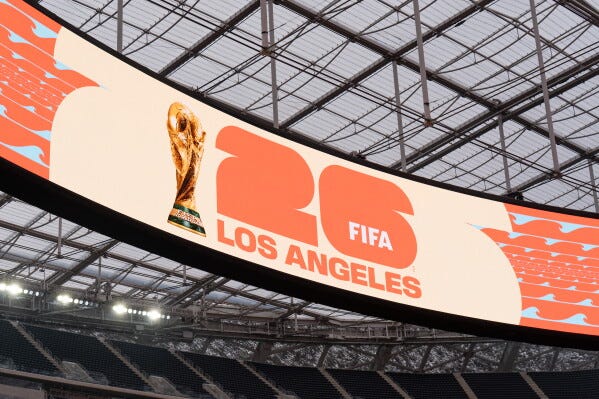
Today more kids play soccer than ever. AYSO has done a fantastic job putting a ball at every kid’s feet. And still, it sits as the third tier sports in the high schools and even in the pros. Soccer stadiums in this country hold about a third of what an NFL stadium holds,( and they do not sell out), which is why FIFA demanded that every World Cup game be played in an NFL building. Maybe that was a test, to see if America could fill the seats. For the most part, we passed. SoFi in Inglewood, which FIFA insisted on calling LA Stadium (there is a whole sermon on sponsorship money hiding in that detail, and I will spare you), sold 70,000 tickets for most of its games. Not a bad showing for a sport that does not crack the top four in the United States or Canada.
So the question everyone asks: did the World Cup move the needle here? I can only tell you what I saw. The streets of Inglewood had marches. The sports bars were full. A fan event drew 5,000 people, most of whom could not recite the Laws of the Game. And yes, soccer calls its rules Laws, capital L, which is either charming or a warning, I have not decided. I learned more about the sport in a month from the professionals working around me than I had in the previous fifty years of ignoring it.
What got me was the fan culture. It is infectious in a way American sports have mostly regulated out of existence. I fell in love with the Dutch, thousands of them, all in orange, dancing in the street to a tune you cannot get out of your head no matter what you do. Norwegians took over Times Square. The Scots drank Boston dry and put traffic cones on the heads of statues, and there is a great story behind why they do that, worth looking up on its own. Sixteen stadiums across three nations, Canada, Mexico, and the United States, and everywhere the same thing: grown men singing in public without a shred of embarrassment. Think about how rare that is. Fandom might be the last place left where a man is allowed unguarded joy in front of strangers. That alone is worth the price of a ticket.
Now, some criticism, because I would not be me without it. The flopping has to stop. Players roll around on the grass like they cannot breathe, like a man who needs last rites, and then the whistle goes their way and they pop up and play on like Lazarus with a sponsorship deal. The Greeks invented both athletics and theater, and they had the good sense to keep them in separate buildings. Somewhere along the way soccer merged the two. It is nearly enough to keep me from watching. I have all but given up on the NBA for the same reason, and I am a Lakers fan, so you know it cost me something to say that.
I love the pride the fans carry for their nations. And like any fan base, a few took the celebrating too far. I am not going to dwell on that, because the experience was overwhelmingly positive, and a man should report the weather he actually stood in, not the storm that made the news.
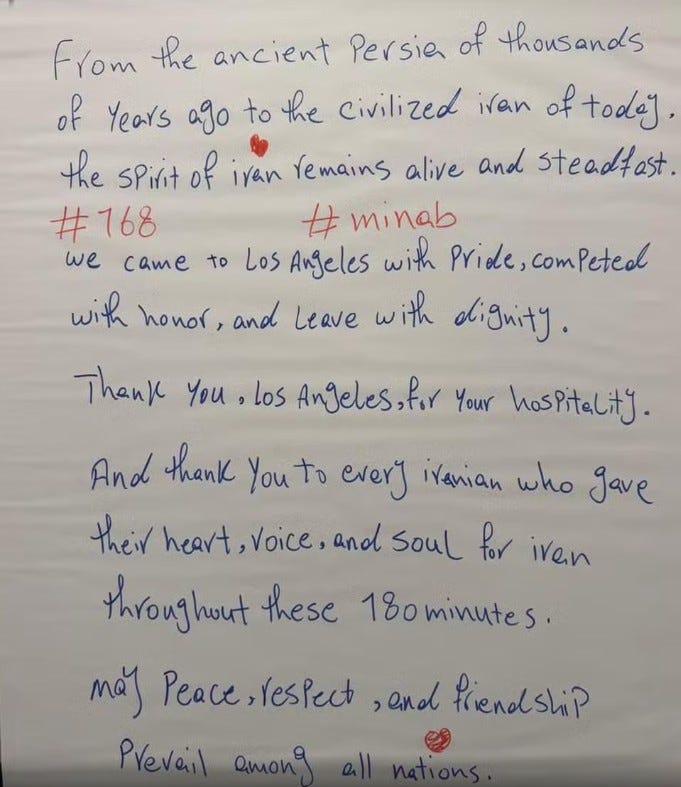
From an operational standpoint, the tournament was a success. The interaction with the fans, the teams, and the visiting nations was outstanding. Even Iran, a country we are in open conflict with, left behind a thank-you note. Sit with that for a second. Somewhere in a filing cabinet in Inglewood there is a polite note from Iran, and I would argue it accomplished more than a few summits I could name. Diplomats spend careers trying to manufacture what a group scheduling conflict and a shared parking lot produced by accident.
This is the part I actually believe in. Sport is meant to break down walls and open doors. I have lived it. When I wrestled as a kid, I traveled, stayed with host families, and learned that the rest of the country was full of people more or less like the ones back home. When I was in the Navy, I played rugby in ports around the world, and it was how we met host nations as people instead of as a fleet. The original Olympics had a word for this: ekecheiria, the sacred truce. The Greeks stopped their wars so the games could go on. We have managed to invert it. Now we stop the games so the arguments can go on. I would suggest the ancients had the order right.
Albert Camus kept goal for his university team in Algiers, and he said that everything he knew most surely about morality and the obligations of men, he owed to football. I doubt he was picturing a planning section in Inglewood when he said it. But after a month inside this tournament, watching strangers from sixty nations find their way to the same songs, the same seats, and the same overpriced beer, I am starting to see what he meant.
At the end of the day, international competition is not about politics and it is not about our differences. It is a patch of common ground with a scoreboard on it. Of course I am rooting for my team, the red, white, and blue of the United States. Camus never said anything about that part. But I like to think he would understand.
That’s about as much diplomacy as a man needs.